


They panned it for years, but today this film seems more ahead of its time than many modern blockbusters
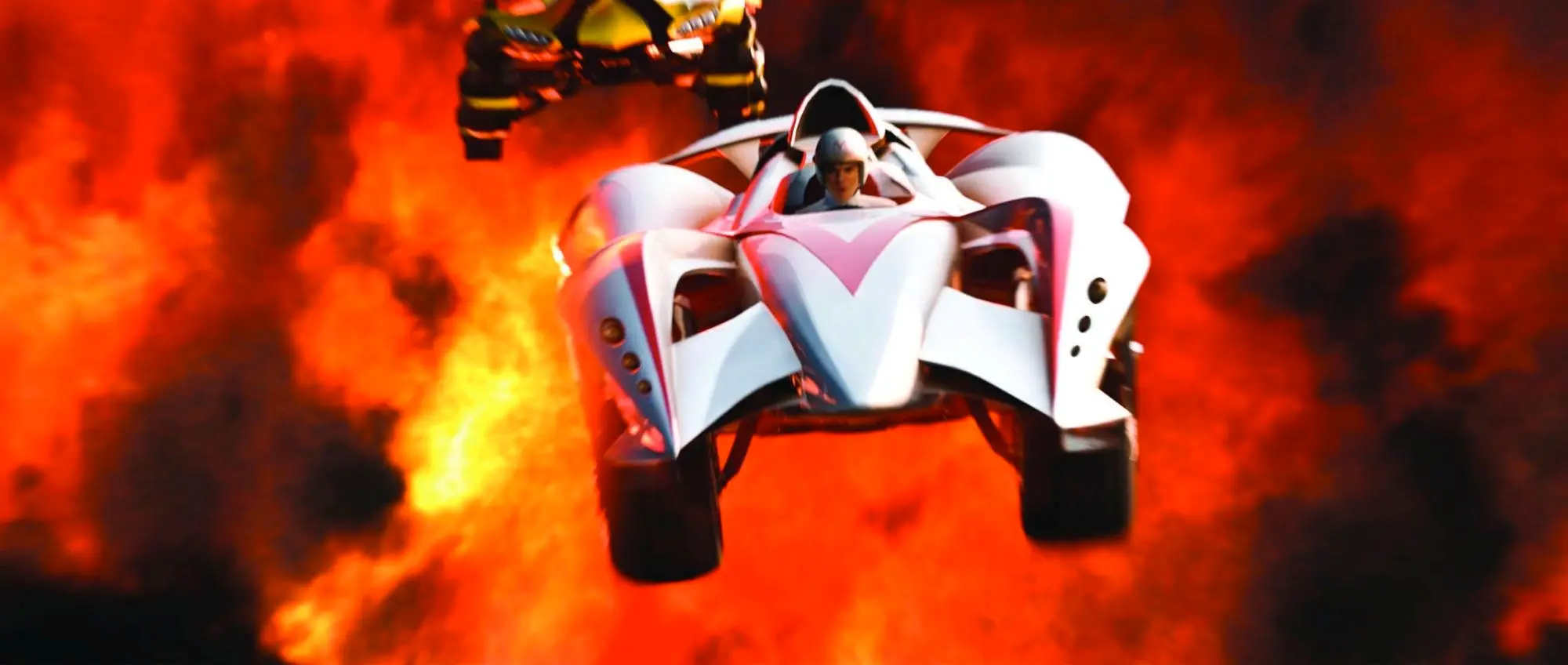
Some films don’t really fail: they simply arrive too early. It’s the case of Speed Racer, the live-action directed by the Wachowskis in 2008 and based on the Japanese anime of the same name, which at the time was met with indifference by critics and disappointing box office results. Today, however, that same film seems to be living a second life: no longer as an out-of-control experiment, but as one of the boldest, most colorful, and sincere blockbusters of the last twenty years.
At the time of its release, Speed Racer had everything to be a major event. It was the first film by the Wachowskis after the conclusion of the Matrix trilogy, featuring a significant cast with Emile Hirsch, Christina Ricci, John Goodman, Susan Sarandon, Matthew Fox, and Roger Allam, and it brought beloved pop imagery to the big screen. Yet the audience of 2008 did not seem ready for its extreme aesthetics, made up of saturated colors, impossible races, digital backgrounds, and a visual language much closer to comics and animation than to the realism dominant in action cinema of those years.
The result was heavy: the film grossed much less than expected and was often dismissed as a flop. But over the years, something changed. Its reputation grew slowly, driven mainly by word of mouth from fans, online essays, video analyses, and discussions that transformed that initial failure into an increasingly evident case of reevaluation. Emile Hirsch himself has recounted several times how he was struck by the strength with which the audience continued to defend the film, eventually considering it a true modern cult.
According to the actor, the problem was not so much the film, but the historical moment in which it was released. In 2008, the audience was heading in a different direction: the success of titles like The Dark Knight and Iron Man was imposing an idea of blockbuster that was darker, more concrete, and seemingly realistic. Speed Racer, on the contrary, was an explosion of overt artifice. It didn’t try to hide the digital: he transformed it into the very heart of his identity.
And it is precisely this, today, that makes it so modern. In an era where many blockbusters seem visually uniform, the Wachowski film retains an immediately recognizable personality. Each race is constructed as a sensory experience, but also an emotional one: it’s not just a show, it’s the way the protagonist discovers who they are, what they love, and what is worth fighting for. Behind the speed, the colors, and the apparent excess, there is indeed a deeply sincere story about talent, family, and the necessity of not bending to a system that wants to turn everything into profit.
That sincerity is perhaps the true reason for its rediscovery. Speed Racer is not afraid of seeming naive, colorful, and exaggerated. It does not make fun of its own starting material, it does not make it “adult” through cynicism, and it does not lower the volume of fantasy to seem more credible. On the contrary, it takes the imagery of childhood seriously and pushes it to the extreme, building a world where emotion matters as much as speed.
It is no coincidence that Hirsch recalled the emotional effect of the ending on the audience of the most recent screenings. The grand final race doesn’t work just because it’s spectacular, but because it encapsulates the essence of the entire film: Speed is not simply trying to win; he is trying to understand what his place in the world is. It is a moment of liberation, almost cathartic, where the overwhelming aesthetics of the Wachowskis meet the purest heart of the story.
Almost twenty years later, the initial failure of Speed Racer therefore seems less definitive. In fact, it almost seems like proof of how out of touch it was with the taste of the moment. Today the film is no longer just “that flop by the Wachowskis”: it is a work that continues to be discussed, loved, and defended precisely because it is different from everything else. An imperfect blockbuster, certainly, but also free, radical, and surprisingly ahead of many contemporary products.
Perhaps the audience wasn’t ready in 2008. Or perhaps, simply, it took time for that colorful universe to be seen for what it truly was: not an excess to be corrected, but a declaration of love for pop cinema in its purest form.
About the Author