
 James Oconner
 Anil Krishna
 Jonathan Millar

Silo Season 3 Episode 7 Ending Explained: What Is Stensen Hiding About The 51 Silos?

© Apple TV+
Apple TV+’s Silo Season 3 is finally starting to answer some of the biggest mysteries in the series. Episode 7, “Radio,” makes a big step in that direction, linking Juliette’s present fight for Silo 18 to the events that created the silos in the first place. The present-day story has important developments, but the real surprise is what the episode hints at about Per Stensen and the purpose of the 51 silos. By the time the credits roll, it’s much harder to see the silos as simply underground shelters meant to save humanity.
The Mission to Silo 17 and Increasing Turmoil in Silo 18
Once Juliette recovers memories that had been deliberately buried, she begins to formulate a deadly plan involving Silo 17. But she knows she can’t simply walk away from her responsibilities in Silo 18, so Lukas Kyle and Patrick Kennedy are sent on a dangerous mission to make contact with the neighboring silo. Their mission is to find a secret system of drainage that could offer the inhabitants of Silo 18 a second chance at life. The system already knows how dangerous Lukas and Patrick can be. That’s the problem. Their knowledge of the old mine shafts and the secret routes between the different parts of the silos makes them just the type of people the authorities don’t want asking too many questions. In fact, behind the scenes, The Algorithm (or “The Voice“) actively marks Lukas and Patrick to ensure they never complete the journey or share what they know.
Things aren’t exactly calm back in Silo 18 either. Camille Sims is tired of Robert Sims leaving her in the dark and confronts him about the covert operations going on inside Judicial. One of the most disturbing discoveries is the presence of “Vitamin D+” in the water supply, used to suppress people’s memories. It’s one of those details that makes the control inside the silo seem even more sinister, because the residents aren’t just being lied to; their ability to remember and question what’s happened to them is being manipulated. Camille’s confrontation hints that Judicial’s hold on Silo 18 is beginning to weaken, and when the pieces fall into place, it might be too late to put things back as they were.
Why Radio Is So Important

“Radio” is not just a reference to a piece of technology. It is something far more dangerous to those who run the silos: communication. For generation after generation, people were told that their own silo was just about the only place left where human life could survive. They know very little reliable information about what lies beyond their walls, and the authorities have every reason to keep it that way. The less people know about the outside world, the easier it is to convince them that the rules inside the silo are necessary.
That’s why the possibility of radio contact with another silo is such a big deal. Imagine growing up thinking that your whole community was cut off from the rest of the world and then finding out that there is another group of people living nearby. Suddenly all those old questions are coming back. Why are the silos separate? Who said you weren’t allowed to talk? What else have the residents been lied to about?
And that may be precisely what makes the situation so dangerous for whoever is really running the experiment. Sometimes you can crush a rebellion. But when people start passing information around, it gets a lot harder to contain.
The “Before Times” Flashbacks: Daniel Keene & Per Stensen

The flashbacks in the episode add another important piece to the puzzle, taking viewers back to the time the silos were being created. This part of the story follows Daniel Keene (Ashley Zukerman), journalist Helen Drew (Jessica Henwick) and Per Stensen (Colin Hanks). These scenes are especially interesting because they reveal that the idea behind the silos was not as simple as building giant underground shelters and waiting for the world above to heal itself.
On the face of it, the project was about saving humanity from an impending catastrophe. This sounds noble enough, but the deeper we go into Stensen’s story, the more uncomfortable the original plan becomes. They were designed to be isolated, secret and controlled, and those things were not accidental by-products of the project. They were built into the system from day one. What was presented as a solution for the survival of humanity starts looking more and more like something calculated.
Here again Stensen becomes more and more important. The flashbacks suggest he knew a lot more about the system than your average architect or administrator would. The big question is if he was just carrying out somebody else’s plan or if he played a much bigger part in deciding what the silos would eventually be.
Who Is Stensen And What Is The Truth Behind The 51 Silos?
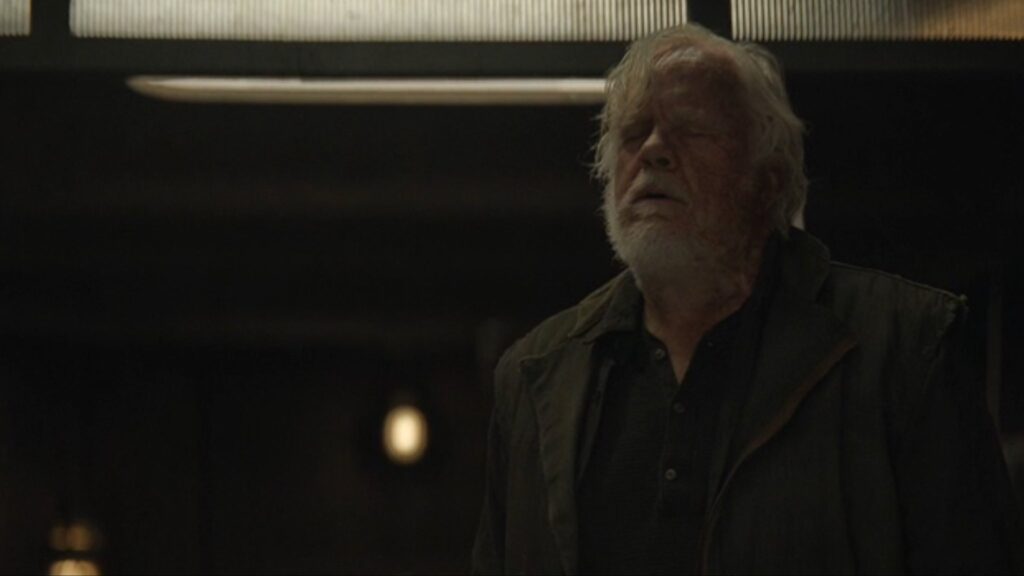
The big reveal in the ending is that the 51 silos are not necessarily to be seen as 51 different shelters. They are part of a much larger system, where each silo is an isolated society, but part of the same underlying structure. That detail matters because it changes the whole point of the experiment. The residents don’t live in separate bunkers because the outside world is dangerous. It seems as if the separation itself serves a purpose.
Keeping the populations separate gives the system tremendous control over what people know and remember. If residents from different silos could talk freely, they could compare notes about their histories, share information and quickly realize something is amiss. One silo might have a story about its past that conflicts with the story of another silo. Someone might find out that a rule they were told was universal is actually special to their own community. Those little contradictions might someday expose the whole system.
That’s also why the authorities get so aggressive whenever a silo gets too close to the truth. A silo that begins to talk to its neighbors or openly challenges the status quo is labeled “contaminated.” When that happens, the system has ways of containing the problem, such as memory suppression and other measures to prevent dangerous information from spreading. In the worst case, the whole population might be eliminated instead of letting the knowledge get to the other silos.
The most disturbing implication of the episode is perhaps this: maybe those 51 silos weren’t only built as shelters for humanity in case of an apocalypse. They appear to be engaged in a gigantic, tightly controlled experiment in human behavior. The populations are isolated, observed and manipulated, but the people within them have no idea their lives are part of a much larger system.
And that places Stensen in a particularly interesting position. If he knew what the 51 silos were really intended for, then his part in the story is much more complicated than it first appeared. Was he one of the people who designed the system, or was he just helping to build something whose real purpose was hidden from him? Episode 7 doesn’t provide us with a full answer, but it certainly makes Stensen less of a straightforward historical figure and more like someone who could have a key piece of the puzzle.
The threat to Juliette is no longer simply about saving Silo 18. If she can reach other silos, she might destroy the one thing the system has struggled for generations to keep from their hands: the truth. And once that truth starts circulating from silo to silo, it may be impossible to send it back underground.
About the Author