
 James Oconner


 Anil Krishna

 Jonathan Millar

Resident Evil Brings the Ultimate Gameplay Experience to the Big Screen in a Superb Survival Horror Film
© Sony Pictures
One of the greatest challenges in adapting video games for film and television is giving viewers an experience that mirrors what they enjoy for hours while holding a controller. The visual language differs, characters often fail to resemble the ones fans have grown fond of, and the lack of interactive decision-making makes it harder for enthusiasts to embrace the translation. While 2026’s Mortal Kombat 2 came close to balancing these elements, it is the new Resident Evil 2026—directed by Zach Cregger of Barbarian fame—that delivers perhaps the finest result since Hollywood first started bringing games to the silver screen.
Following the entertaining six-film run directed by Paul W.S. Anderson and starring Milla Jovovich, alongside the lackluster Welcome to Raccoon City starring Kaya Scodelario, Zach Cregger chose to forge a completely new narrative path. By avoiding the games’ familiar main characters, the plot captures the true atmosphere of Resident Evil gameplay far better than any previous adaptation.
The premise is straightforward: Bryan (Austin Abrams) works in organ transport. After arriving at a hospital for a delivery, he receives an urgent new assignment that must be rushed to Raccoon City. En route, he accidentally hits a woman with his car and soon discovers that the world is on the brink of collapse—and that it all traces back to his final destination.
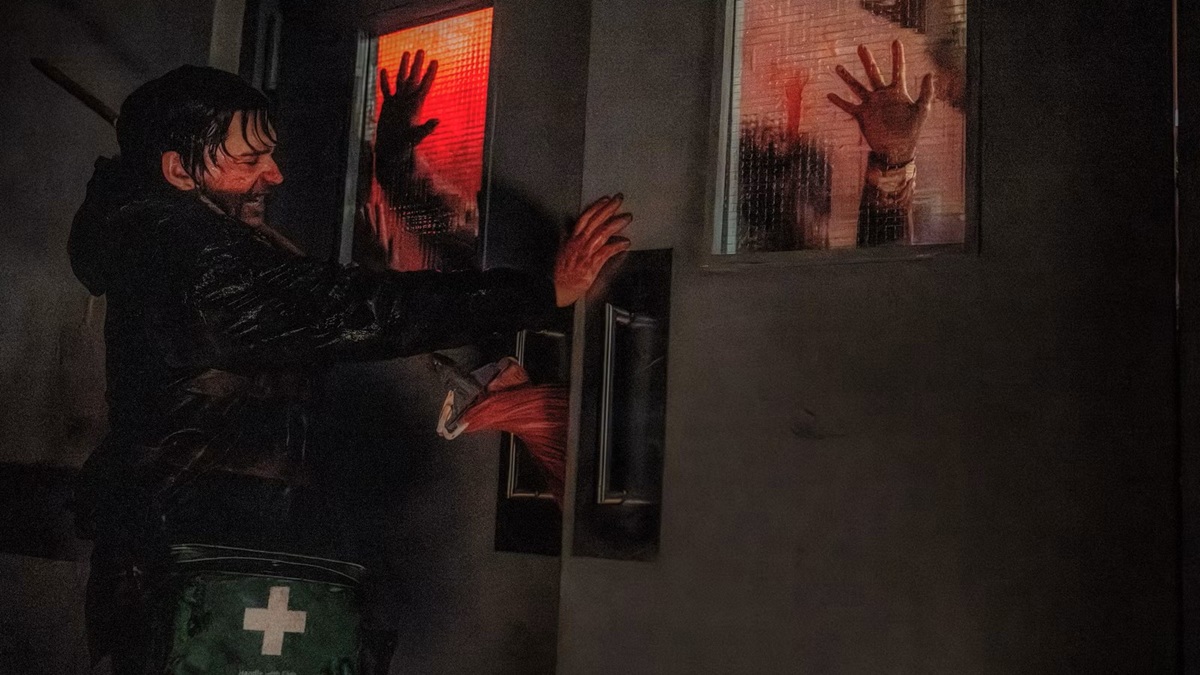
The plot’s simplicity stands in stark contrast to the meticulous care Cregger brings to the direction. Right from the start, as Bryan enters the hospital, his surroundings feel lifted straight from a video game: NPCs stand completely still or move minimally, failing to respond—or merely stepping aside—even when the protagonist stops directly in front of them. He only manages to make contact when a doctor reacts and takes the organ cooler, a moment that quickly transitions into a cutscene where Bryan speaks with another staff member.
This emulation of gaming language stays with Resident Evil throughout the entire runtime. From scenes of a car driving along a snow-covered road to the moment Bryan is pulled over by a police officer—including the first-person shooting sequences—the sensation of playing a game is phenomenal. If visual fidelity is the benchmark, no one has achieved anything quite like what Cregger pulls off across these 90 minutes of survival horror. Perhaps only the famous first-person sequence in Doom (starring The Rock and Karl Urban) and the recent fight between Liu Kang and Kung Lao in MK2 come close to this level of precision regarding visual language and dynamics. However, those were isolated moments in their respective works, whereas Resident Evil sustains this style across nearly its entire narrative.
The final act features moments that play with “quick-time events”—popularized by Shenmue, God of War, and Resident Evil itself—culminating in a major set-piece where the director unleashes his full visual madness. At this point, the nods to John Carpenter’s The Thing are unmistakable. In fact, those allusions are present right from the beginning: the freezing setting, the use of animals, and, naturally, the creature designs and practical effects.
Austin Abrams deserves immense praise. Like Bryan, he carries the film, frequently appearing entirely on screen by himself. The actor, who previously distinguished himself in television roles across Euphoria, Dash & Lily, and This Is Us, handles it all: running, shooting, suffering, screaming, and cracking jokes. He does a fantastic job shaping Bryan into an inexperienced Resident Evil player. We watch the delivery driver figure out the mechanics of the infected, learn how to use available weapons, scavenge for supplies in drawers or under furniture, and react to jump scares, monsters, and bizarre situations exactly like someone picking up a controller for the first time.
Another element that works exceptionally well in the partnership between Cregger and Abrams is the humor. Unlike the somber tone of previous films in the franchise—or what die-hard fans might assume is mandatory for these stories—laughter goes hand-in-hand with tension. Better yet, it helps disarm the audience before the jump scares and gorier moments hit. The director already proved he could pull this off in the excellent Barbarian, but here, anchored by his lead actor’s superb performance, he achieves even better results.
Resident Evil is as hilarious as it is bizarre and tense—a massive achievement for Cregger as a filmmaker. It builds on the signature style of his recent work and refines it even further for this adaptation. Above all, it proves that film adaptations can respect a source material’s identity while creating something fresh, playing with genres, and telling stories without relying on a fandom’s legacy characters. The scares are there. The gore is there. But there are also fresh elements, a great protagonist, and a plot that doesn’t require a crash course in deep lore.
Ultimately, the Resident Evil movie is about experiencing that world: feeling the tension, trying to peek around a corner, fearing what a flashlight might reveal in a dark corridor, and recoiling at the grotesque results of the Umbrella Corporation’s experiments. Because that is precisely what the Resident Evil games have always been about, Zach Cregger’s adaptation stands as a rare success.
About the Author


1 thought on “Resident Evil Brings the Ultimate Gameplay Experience to the Big Screen in a Superb Survival Horror Film”