
 Anil Krishna
 Jonathan Millar

 James Oconner
Monster: The Lizzie Borden Story Review — True Crime Meets Dark Fairy Tale and Grand Guignol

© Netflix
“Lizzie Borden took an axe / And gave her mother forty whacks / When she saw what she had done / She gave her father forty-one.” So goes the grim nursery rhyme—a staple of American folklore—that closes the prologue of Monster: The Lizzie Borden Story. Within these opening five minutes, the titular protagonist, axe in hand, carries out the exact acts described in those famous lines (give or take a few strikes). Set on August 4, 1892—the night of one of the 19th century’s most endlessly debated true-crime cases—the scene serves as a manifesto for the new Netflix series. Trading the hyper-realism of previous seasons for Grand Guignol violence, the show leans heavily into the grotesque, venturing near Quentin Tarantino territory.
This stylistic shift is the defining feature of Season 4. Created in 2022 by Ryan Murphy and Ian Brennan, the anthology series kicked off with serial killer Jeffrey Dahmer, followed by the Menendez brothers and Ed Gein. Ian Brennan returns as showrunner and sole writer for all eight episodes—with Murphy serving strictly as executive producer this time—and immediately sets out to chart new territory. Moving away from the mid-to-late 20th century, the show adopts a 19th-century backdrop where straight factual crime reporting gives way to the atmosphere of a dark, twisted fairy tale.
Ella Beatty’s Lizzie Borden: Equal Parts Cinderella and Carrie
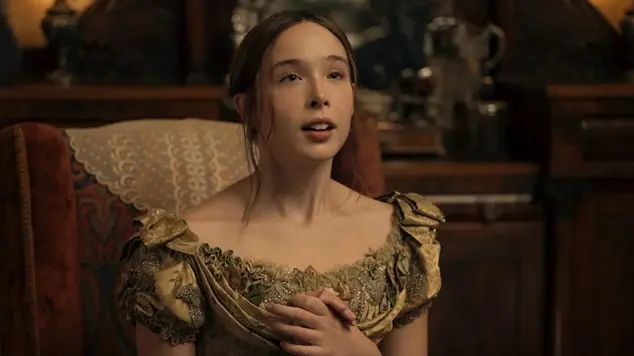
The setup echoes classic folklore. Rewinding four months from its bloody opening, the series paints a portrait of a lovely young woman trapped in a loveless home, complete with a literal stepmother who loses no opportunity to demean her. Lizzie possesses delicate features and a gaze suspended between innocence and wonder, courtesy of Ella Beatty (the 26-year-old daughter of Warren Beatty and Annette Bening). Marking her first leading role after being cast by Murphy in Feud: Capote vs. The Swans, Beatty brings a quiet intensity to the role. Meanwhile, her stepmother, Abby Borden, is played by Rebecca Hall with the sneering cruelty of a classic fairy-tale villain.
The first three episodes—directed by Monster veteran Max Winkler—lay the groundwork for the brutal double murder, establishing a backstory that offers if not an outright justification, then at least significant mitigating circumstances. Beatty’s Lizzie is simultaneously a 19th-century Cinderella and a Carrie ahead of her time. Much like Stephen King’s tragic heroine, she gets her period—which becomes an immediate target of disgust and ridicule—right after being rejected by a prospective suitor. Lizzie embodies the stifling female condition in a bourgeois patriarchal society, where a woman’s sole path to agency is becoming someone’s wife.
Love, Rebellion, and Bloodbaths
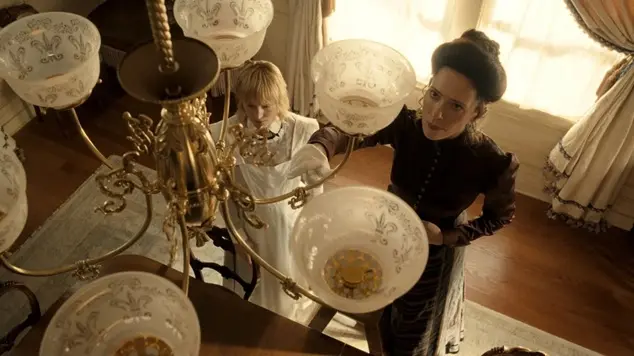
Enter Bridget Sullivan (played by the graceful Vicky Krieps), the Borden family’s new maid, who blows open Lizzie’s world. Skilled in the kitchen and relentless in her work, Bridget’s gentle, composed nature stands in sharp contrast to Abby’s hysterical domineering (she insists on calling Bridget “Maggie,” after the previous maid) and the cold indifference of the patriarch, Andrew, played by Charlie Hunnam. Predictably, Bridget wins Lizzie over, showing her a level of warmth and affection she has never known. She looks past the family’s dynamic, feeds Lizzie’s imagination with tales of Countess Erzsébet Báthory, and even introduces her to the pleasures of an early vibrator.
From Episode 1, “Bloodbath,” the story transforms into an unconventional coming-of-age tale. The show captures Lizzie’s awakening through anachronistic musical choices: her yearning for rebellion is underscored by the roaring anthem “Cherry Bomb” by Joan Jett’s The Runaways—a track that mirrors the on-screen action, down to a visual parallel between Countess Báthory’s blood baths and Lizzie and Bridget soaking in cherry juice. Meanwhile, their romantic idyll is set to the dreamy melody of Kate Bush’s “Hounds of Love.” The series officially pivots into true crime in Episode 2, “Strong Kitty,” as murderous intent turns into action.
The Verdict
While earlier seasons of Monster played things straight as pure drama, the criminal acts in the first three episodes of The Lizzie Borden Story unfold somewhere between campy Grand Guignol and surreal dark comedy—evidenced by pseudo-legendary digressions about Erzsébet Báthory and cartoonish poison-vomit sequences. Depth is occasionally sacrificed on the altar of macabre entertainment, but the series achieves a narrative balance that is no small feat given the stylistic risks. Anchored by a strong core ensemble, the show succeeds as a genre hybrid—teetering deftly between feminist parable, social critique, and visual spectacle.
About the Author

1 thought on “Monster: The Lizzie Borden Story Review — True Crime Meets Dark Fairy Tale and Grand Guignol”