 James Oconner


 Anil Krishna
 Jonathan Millar

‘Widow’s Bay’ Made Emmy History: What It’s About and Why It Became a Phenomenon
© Apple TV+
With 14 wins at the 2026 Emmys, Apple TV+’s Widow’s Bay had a pretty ridiculous night. The horror-comedy picked up 14 trophies from 19 nominations, setting a new record for the most Emmy wins by a comedy in a single season. For a show that doesn’t really look or behave like a traditional sitcom, that’s quite a way to announce yourself.
Created by Katie Dippold, Widow’s Bay has somehow managed to mix sharp comedy with creepy local folklore, monsters, small-town paranoia and a whole lot of superstition. None of those things should necessarily fit together as neatly as they do here, but that’s part of the reason the series became such a surprise hit. It’s funny, then suddenly unsettling, and sometimes both at the same time. If you’re only just hearing about it now, there’s a lot going on beneath that Emmy haul.
What Is ‘Widow’s Bay’ About?
The series takes place in Widow’s Bay, an isolated fictional island community somewhere off the coast of New England. It’s the sort of place that feels like it got left behind a few decades ago. Cell service barely works, the internet is almost useless, the local economy is struggling, and the people who live there have an impressive number of strange rules and superstitions they apparently take very seriously.
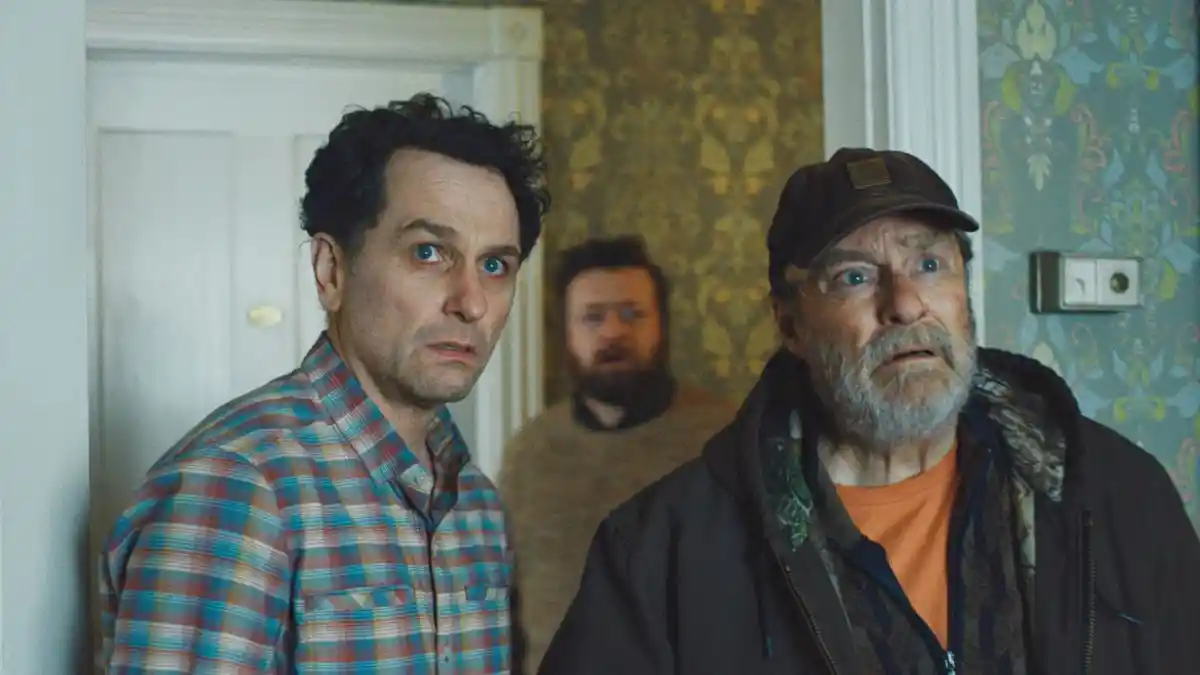
That becomes a problem for Mayor Tom Loftis (Matthew Rhys), who is desperate to give the island some kind of future. His solution is fairly simple on paper: turn Widow’s Bay into a tourist destination and bring some money back into the community. Tom is thinking about the economy and, more personally, about giving his son Evan a reason to stay. The locals aren’t exactly thrilled, though. They believe the island is cursed and are convinced that filling it with outsiders could wake up things that are better left alone.
Tom, being Tom, doesn’t put much stock in any of that at first. Then the tourism plan starts working, and suddenly all those old stories don’t seem quite so silly anymore. Strange things begin happening around the island, and the legends people have been warning about start making their way into everyday life. Eventually, even Tom has to consider the possibility that the locals knew what they were talking about all along.
A Mashup of Stephen King and ‘Jaws’
One of the more interesting things about Widow’s Bay is that it doesn’t build the entire season around one big mystery and then save the answer for the finale. Instead, the island itself becomes the playground. The show keeps adding pieces to its supernatural mythology as it goes, which gives it a slightly anthology-like feel even though the same characters remain at the center of everything.
That’s also where some of the comparisons to Stephen King, Twin Peaks, The Fog, and Jaws come from. There’s the isolated community, the strange local legends and, especially, the idea of a town desperately trying to keep its tourist business alive while something very unpleasant is lurking nearby. Tom’s situation in particular has shades of Jaws, except this time the mayor has to worry about considerably more than one shark.
The cast helps sell the whole thing, too. Alongside Rhys, the series features Kate O’Flynn as Patricia, Stephen Root as Wyck, Kingston Rumi Southwick as Evan, Kevin Carroll as Bechir, and Dale Dickey as Rosemary. These characters are odd, stubborn and not always particularly sensible, but they feel like people who actually belong on the island. More importantly, most of them are much quicker than Tom to accept that something seriously strange is happening around them.
Why It Works: Genuine Scares Meets Real Laughs
The easiest way for a horror-comedy to fail is to make the horror feel like a joke. Widow’s Bay mostly avoids that trap. When the show wants to be scary, it actually lets the scary stuff play out instead of immediately undercutting it with a gag. And when it is funny, the jokes usually come from the characters themselves and the ridiculous situations they’ve found themselves stuck in.
Dippold has traced the idea behind the show back to a childhood memory of walking past a supposedly haunted house with friends. There was fear there, obviously, but also the kind of laughter that tends to happen when you’re scared and don’t quite know what else to do. That feeling seems to be at the center of Widow’s Bay. It isn’t constantly jumping from horror scene to comedy scene; quite often, the two things are happening together.
That helps explain why the series has drawn comparisons to such a strange collection of influences, from David Lynch and Parks and Recreation to Northern Exposure and Halloween. On paper, those references don’t have much business sitting next to each other. Somehow, Widow’s Bay makes the combination work.
Sweeping the 2026 Emmys
All of that clearly connected with voters at the 2026 Emmys. Widow’s Bay finished with 14 awards across the Creative Arts and main telecast ceremonies, giving it the record for the most Emmy wins by a comedy in a single season. It also took home Best Comedy Series, while Dippold won for writing and Hiro Murai won for directing.
The acting categories were just as good to the show. Matthew Rhys, Stephen Root and Kate O’Flynn all picked up acting trophies, adding to what was already an unusually big night for the series.
Rhys had an especially unusual evening because he won Best Lead Actor in a Comedy for Widow’s Bay and Best Lead Actor in a Limited Series for The Beast in Me on the same night. Add his 2018 Emmy win for The Americans, and Rhys became the first male actor in Emmy history to win lead acting awards in drama, comedy and limited series categories.
Redefining TV Comedy
It’s hard to look at Widow’s Bay winning the comedy record and not notice how strange the whole thing is. This is a show about ghosts, monsters, gruesome folklore and people worrying that their island might be cursed. There are plenty of jokes, but it isn’t trying to fit neatly into the usual idea of what a comedy is supposed to be.
And maybe that’s the bigger reason the show caught people off guard. Widow’s Bay doesn’t seem particularly interested in choosing one genre and sticking with it. It can be funny and creepy in the same scene, sometimes without making a big deal about the switch. The fact that a show this weird just made Emmy history says quite a bit about how much room television has now for series that don’t fit into one easy category.
About the Author