 James Oconner
 Anil Krishna
 Jonathan Millar

House of the Dragon Season 3: Why Helaena’s Death Is So Different From the Book
© HBO
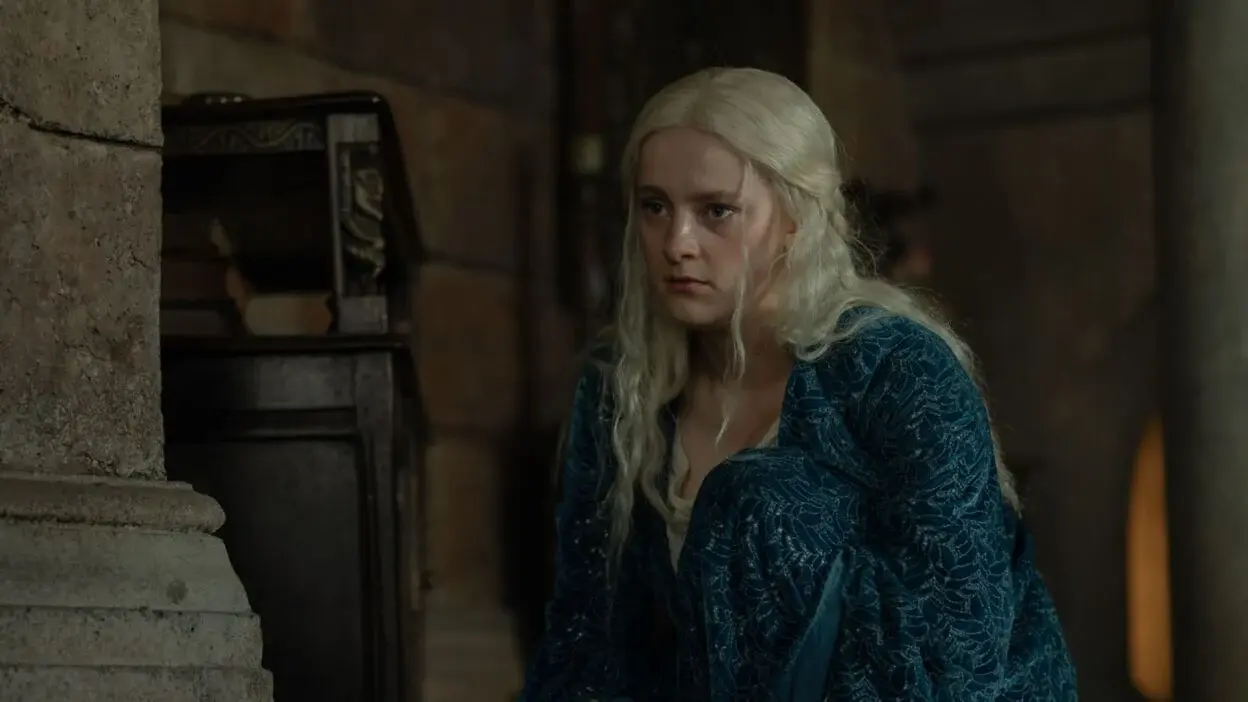
The Season 3 finale of HBO’s House of the Dragon delivers one of the most heartbreaking moments of the Dance of the Dragons with the death of Helaena Targaryen. Her fate was always going to be a difficult part of the story, since George R.R. Martin’s Fire & Blood already establishes that Helaena eventually dies by jumping from a window in the Red Keep. But the show takes a very different route to get her there. Instead of making her death primarily about grief and the loss of her children, the series turns it into a final decision over her own life and the future of the child she is carrying.
How Helaena Dies in the Show
In House of the Dragon, Helaena is living as a prisoner in the Red Keep after Rhaenyra takes control of King’s Landing. She has lost almost all control over her own life and is treated less like a member of the royal family who needs protection and more like someone who can be useful to whichever side happens to control the city. That becomes even more disturbing when Helaena realizes that her pregnancy could make her unborn child another piece in the political fight between Rhaenyra and the Greens.
Eventually, Helaena confronts Rhaenyra about what is happening to her. She understands that if she continues the pregnancy, the child could simply become another political weapon in the war. Rather than allowing that to happen, Helaena makes the decision herself. She jumps from a window in the Red Keep onto the iron spikes below, dying along with her unborn child. The series also gives the moment a prophetic twist that isn’t part of the same scene in Fire & Blood. Before her death, Helaena leaves Rhaenyra a finished tapestry showing a disturbing vision of the future, with Rhaenyra sitting on the Iron Throne while blood drips from the crown and dragonfire surrounds her. It gives Helaena’s final moments an almost haunting quality, as though she knows exactly where all of this is heading.
Phia Saban, who plays Helaena, has explained that the decision was meant to be about more than simply having her character reach a breaking point. In an interview with Variety, Saban discussed how the show’s decision to leave Maelor out of the story changed Helaena’s circumstances. Her pregnancy gives her a different reason to make the choice she does, because she can see that her child is likely to become another hostage in the war. Saban also told showrunner Ryan Condal and writer Sara Hess about an idea from George Bernard Shaw’s Saint Joan, specifically the notion that living is not simply the opposite of being dead. That helped shape the idea that Helaena’s final decision is about taking back some control over her life rather than simply giving up. Saban has also spoken about filming her scenes with Dreamfyre on the mechanical buck and receiving the large prophetic embroidery from Condal as a wrap gift, which makes the tapestry an especially meaningful part of her time on the series.
What Happens to Helaena in Fire & Blood?
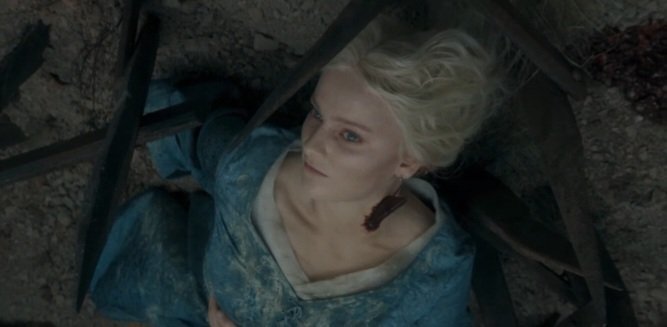
The basic manner of Helaena’s death is actually the same in Fire & Blood. She jumps from a window in the Red Keep and falls onto the spikes below. The circumstances surrounding that moment, however, are very different.
In the book, Helaena and Aegon II have three children: Jaehaerys, Jaehaera and Maelor. Her life begins to unravel after the horrifying Blood and Cheese incident, when assassins enter the Red Keep and force Helaena to choose which of her sons should die. She chooses Maelor, believing that saving him is the only way to spare at least one of her children. The assassins kill Jaehaerys instead, leaving Helaena devastated. From there, she falls into a deep depression, and her condition only becomes worse as the war continues.
Her situation becomes even more unbearable when news reaches King’s Landing that Maelor has been killed at Bitterbridge while being taken out of the capital. Helaena has now lost both of her sons, and the emotional damage finally becomes too much for her. Her suicide in the book is therefore closely tied to grief and the unbearable loss of her children. It is a very different motivation from what the series gives her.
There is also a memorable detail involving Dreamfyre that the show does not use in exactly the same way. In Fire & Blood, Helaena’s death has an immediate effect on her dragon. Dreamfyre senses that something has happened, breaks free from her chains and lets out such a powerful roar that it shakes the Dragonpit. The moment reinforces the strange and powerful connection between Targaryens and their dragons, something the books return to throughout the Dance of the Dragons.
Why Did the Show Change Helaena’s Story?
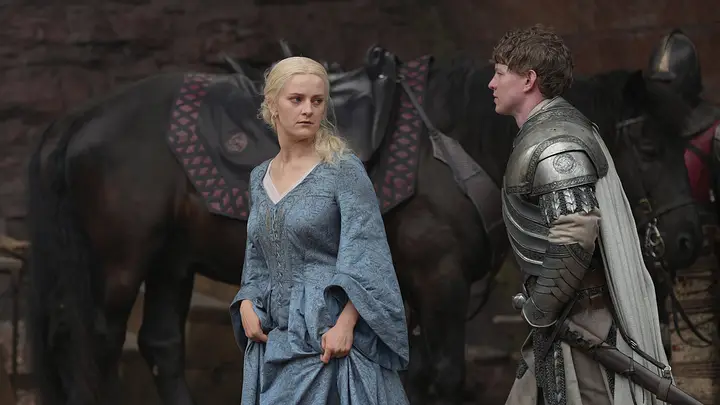
The biggest reason for the change is actually pretty straightforward: Maelor isn’t part of the show’s story at this point. Because the series removed one of Helaena and Aegon’s children, it couldn’t simply recreate the chain of events from the book. Instead, the writers had to find another reason for Helaena’s death that fit the version of her story they had already established.
The pregnancy provides that alternative. In Fire & Blood, Helaena is overwhelmed by what she has already lost. In House of the Dragon, she is terrified of what could happen next. She knows that the child she is carrying could be taken from her and used by either side as another political tool. That changes her suicide from something driven primarily by grief into something much closer to a final act of control. Helaena doesn’t want to spend the rest of her life trapped in the Red Keep while other people decide what happens to her and her children.
That difference also makes her death much more damaging to Rhaenyra. Helaena dies while she is effectively a prisoner under the Black Queen’s rule, which means Rhaenyra cannot simply dismiss the tragedy as another casualty of the war. Even if Rhaenyra never directly kills Helaena, her treatment of her and the circumstances surrounding her final days leave a stain on her reign. It also makes the possibility of peace between Rhaenyra and Alicent Hightower even harder to imagine.
Helaena’s Death Changes What Rhaenyra’s Rule Means
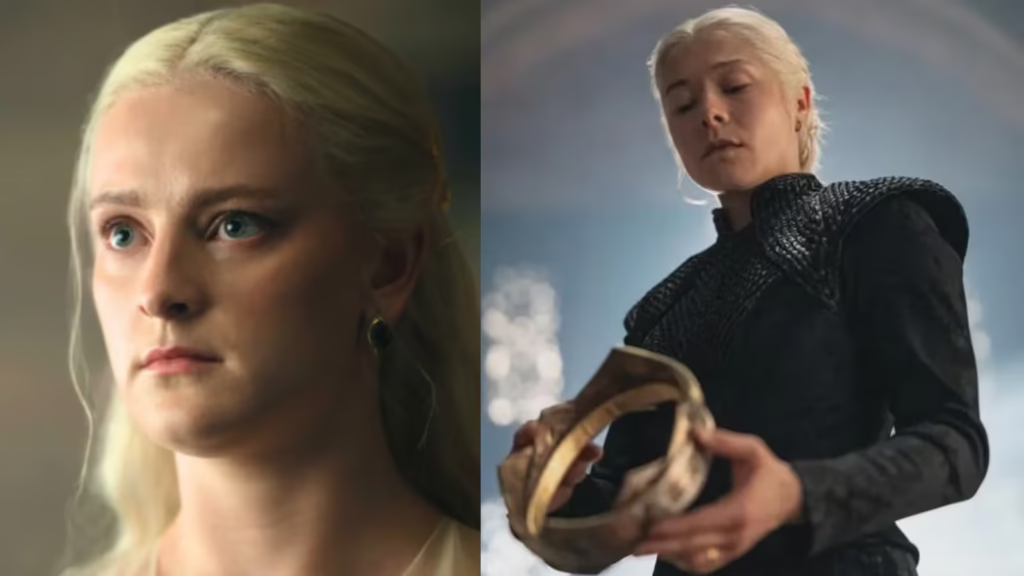
One of the most interesting things about the show’s version of Helaena’s death is what it says about Rhaenyra. Earlier in the series, Rhaenyra often presented herself as someone who could break the cycle of cruelty surrounding the Iron Throne. She had seen what power did to her father and understood how easily the people around a ruler could become expendable. But by the time she takes King’s Landing, the pressure of the war has changed her.
Helaena’s death becomes another sign that Rhaenyra is losing the ability to see the human cost of her decisions. She believes she is fighting for the good of the realm, but from Helaena’s perspective, she is simply another powerful person deciding what happens to her. That’s what makes the scene so painful. Helaena isn’t dying because she wants to help the Greens or because she suddenly becomes a willing participant in the war. She is trying to escape a situation in which everyone else has been making choices for her.
The change also fits with the show’s larger approach to the Dance of the Dragons. Fire & Blood often presents these events as a historical record, leaving readers to piece together what actually happened from conflicting accounts. House of the Dragon has more freedom to put characters’ emotions at the center of the story. In Helaena’s case, that means turning a tragic death mentioned in the history of Westeros into a deeply personal decision that says something about captivity, motherhood and the cost of the Targaryens’ war.
In the end, both versions of Helaena’s story are tragic, but they hurt in very different ways. The book’s Helaena is destroyed by grief after losing her children, while the show’s Helaena chooses death because she refuses to let her unborn child become another piece on the board. The destination is the same, but the journey is completely different. And by placing that death inside Rhaenyra’s occupied Red Keep, the series makes sure that Helaena’s final choice isn’t just another tragedy of the Dance—it becomes one of the moments that defines what Rhaenyra’s rule has become.
About the Author